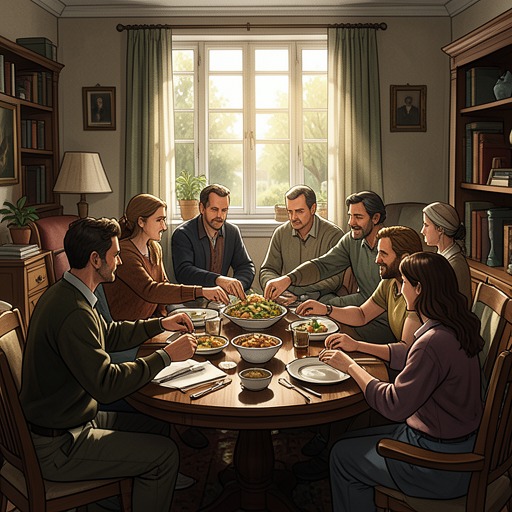
Gu Family
I’m Very Happy After Marrying the CEO Husband According to the AgreementThe Gu Family is the dominant kinship organization surrounding Gu Huaian, and its influence reaches far beyond private domestic life. It includes the central household, side branches, senior elders, and younger members whose attitudes are shaped by the family’s hierarchy. The family’s decisive role is to convert marriage into a matter of collective reputation and authority: Shen Tang’s agreement with Gu Huaian begins as a carefully managed transaction, but her position within the Gu Family gradually becomes socially visible and emotionally consequential.
Structure and Authority
The Gu Family is presented as an extended clan rather than a small nuclear household. When Shen Tang is told that a visit to the old house will include the entire Gu clan, including its side branches, the ordinary idea of a family dinner gives way to a large gathering governed by rank. Tao Sister explains that Gu Huaian is now the head of the Gu Family, which means that other relatives are more likely to flatter Shen Tang than challenge her. The family’s internal order therefore rests on Gu Huaian’s authority, but it is also reinforced by the symbolic approval of the older generation.
That hierarchy becomes explicit when Shen Tang enters a formal banquet with Gu Huaian. The gathering is composed of people seeking cooperation rather than open conflict, and the couple’s arrival attracts attention. Gu Huaian introduces Shen Tang as his wife while bringing her to greet two benevolent elders. In this setting, the title of wife is not merely a private description; it is a public credential that determines how others read her place in the clan.
Elders and Social Recognition
Old Madam Gu and Old Master Gu occupy the decisive ceremonial position within the organization. Their attitude toward Shen Tang determines the attitude of the other Gu family members, so their acceptance functions almost like an institutional endorsement. Old Madam Gu treats Shen Tang with conspicuous intimacy and personally introduces her to several important elders before allowing the younger generation to separate from the main group. The sequence shows how recognition travels downward through the family: approval from the senior household grants Shen Tang legitimacy among relatives who might otherwise have judged her through rumor or status.
This arrangement also reveals the family’s dependence on visible performance. Shen Tang must appear as Gu Huaian’s loving wife, while the family gathering turns that appearance into a shared social fact. The marriage agreement had originally required only occasional family dinners and the maintenance of a loving-couple image, in exchange for a monthly payment of five million and a two-hundred-million settlement after two years. Within the Gu Family, however, the contractual origin of the relationship is concealed behind ceremony, introductions, and the language of kinship. The household’s public rituals make an arrangement look like an established marriage.
Marriage, Control, and Negotiation
Gu Huaian’s choice of Shen Tang was initially shaped by family pressure. He had Assistant Cen select a suitable marriage candidate because the family demanded one. Shen Tang’s scandals made her publicly vulnerable, but her lack of troublesome relatives, weak connections, and dependence on her manager made her appear easier to control. The Gu Family thus influences the marriage before Shen Tang has any meaningful place within it: it creates the pressure, defines the desired candidate, and helps establish the conditions under which Gu Huaian can manage the arrangement.
Yet the family’s authority does not produce simple obedience. When Gu Qing'an is asked whether a child may go and play with Shen Tang, she unexpectedly agrees after learning that the possible consequences have already been discussed. She accepts that those who make the decision must bear its consequences and treats the matter as a trial rather than an automatic reason for prohibition. Her response presents the Gu Family as capable of negotiation as well as control. It also gives Gu Qing'an an independent moral and practical judgment within the clan’s larger structure.
The family’s power remains visible in Gu Huaian’s response to Shen Tang’s reunion with the Shen family. When blood testing confirms that Shen Tang and the Shen family are related, Gu Huaian refuses to let her move permanently into the Shen family home. He accepts that she may stay for a few days, but insists that she continue living in his vacant house, because she is his wife and belongs in their shared household. His position combines personal possessiveness with the logic of Gu Family marriage: legal and domestic affiliation with the Gu household is treated as a continuing obligation even after a blood relationship elsewhere has been confirmed.
Blood Kinship and Competing Families
The Gu Family’s organization is set against the Shen family’s scholarly household and against the substitute family represented by the orphanage. Shen Tang’s eight-year-old “brother” from the orphanage is not related to her by blood, yet she has spent her savings supporting the children there, and the original Shen Tang pursued success partly to protect them. This contrast makes the Gu Family’s authority one form of family belonging among several. The narrative does not treat blood, law, residence, and care as identical: each creates a different claim upon Shen Tang.
The later confirmation that Shen Tang has a blood relationship with the Shen family does not erase the Gu Family’s claim over her daily life. Instead, it produces a conflict between biological reunion and marital residence. Gu Huaian’s intervention shows that the Gu Family understands family through household placement and marriage as much as through ancestry. Shen Tang is simultaneously a returned member of the Shen family and the wife publicly recognized by the Gu Family, and the tension between those identities exposes the practical limits of sentimental definitions of kinship.
The clan’s marriage politics also appear in its relationship to other families. Young Master Zhou says that he and Shen Lan are engaged, but Shen Lan immediately states that she never agreed to the arrangement. The encounter illustrates the wider social world in which families attempt to organize relationships through status and inherited expectations. Against such arrangements, Shen Tang’s own contractual marriage appears less romantic but more explicitly negotiated: its terms are written down, its duration is fixed at two years, and its financial consequences are specified, even though the Gu Family later treats it as a public marital bond.
Narrative Function and Development
The Gu Family functions as both a source of pressure and a mechanism of protection. Its demand for Gu Huaian to marry initiates the contract that brings Shen Tang into his life, while its hierarchy makes her vulnerable to collective judgment. At the same time, Gu Huaian’s position as family head shields her at clan gatherings, and the elders’ favorable treatment gives her social standing that she could not easily secure as a scandal-plagued Z-list celebrity whom online rumors had branded with a succession of hostile epithets.
Its importance therefore lies in the contradiction between appearance and belonging. The family relies on performance—introductions, dinners, titles, and the appearance of a loving couple—but those performances gradually acquire real consequences. Shen Tang begins as someone selected because she seems controllable and unconnected. She becomes someone whose presence affects the attitudes of senior relatives, whose residence is defended by Gu Huaian, and whose possible future with him is discussed in terms of a wedding. When asked when she and Gu Huaian plan to marry, Shen Tang cannot give a definite answer because she entered marriage without the ceremony she once imagined. The question nevertheless shows how far the Gu Family’s public framework has moved beyond the original agreement: a temporary contract has become a relationship that others expect to continue into a conventional family future.
The Gu Family thus embodies a layered model of household power. It is a clan organized by seniority, reputation, and the authority of its head, but it is not portrayed as wholly uniform. Elders confer legitimacy, side branches follow signals from the center, individual women such as Gu Qing'an negotiate decisions with breadth of mind, and Gu Huaian uses his position both to control Shen Tang’s place and to protect it. Through this organization, the story tests whether family is defined by blood, contract, residence, public recognition, or sustained care—and shows that, for Shen Tang, all of these forms can claim her at once.